Practice Test Microsoft AZ-700 Fee & Exam AZ-700 Success
Wiki Article
P.S. Free 2026 Microsoft AZ-700 dumps are available on Google Drive shared by BraindumpsPrep: https://drive.google.com/open?id=1Xa2m5SHduMBr6RqtUiJ5YSgY0ucRHwY1
For candidates who will buy AZ-700 training materials online, they may pay more attention to privacy protection. We respect your private information, and your personal identification information will be protected well if you choose us. Once the order finishes, your personal information will be concealed. In addition, AZ-700 Exam Dumps contain not only quality but also certain quantity. It will be enough for you to copyright. In order to build up your confidence for AZ-700 exam dumps, we are pass guarantee and money back guarantee, if you fail to copyright, we will give you full refund.
Microsoft AZ-700 is a certification exam designed for professionals who want to showcase their expertise in designing and implementing copyright networking solutions. AZ-700 exam is intended for individuals who have experience in Azure networking and are looking to advance their career by demonstrating their skills and knowledge.
Microsoft AZ-700 Exam Syllabus Topics:
| Topic | Details |
|---|---|
| Topic 1 |
|
| Topic 2 |
|
| Topic 3 |
|
| Topic 4 |
|
| Topic 5 |
|
>> Practice Test Microsoft AZ-700 Fee <<
Pass Guaranteed Quiz Microsoft - AZ-700 Newest Practice Test Fee
To assimilate those useful knowledge better, many customers eager to have some kinds of AZ-700 learning materials worth practicing. All content is clear and easily understood in our AZ-700 exam guide. They are accessible with reasonable prices and various versions for your option. All content are in compliance with regulations of the AZ-700 Exam. As long as you are determined to succeed, our AZ-700 study quiz will be your best reliance.
Microsoft AZ-700: Designing and Implementing copyright Networking Solutions is a certification exam that is designed for individuals who are interested in gaining proficiency in various Azure networking solutions. AZ-700 Exam is designed to test the knowledge and skills of the individuals in designing and implementing Azure networking solutions, including virtual networks, load balancing, and network security.
Microsoft Designing and Implementing copyright Networking Solutions Sample Questions (Q198-Q203):
NEW QUESTION # 198
You have an Azure virtual network named Vnet1 that contains two subnets named Subnet1 and Subnet2.
You have the NAT gateway shown in the NATgateway1 exhibit.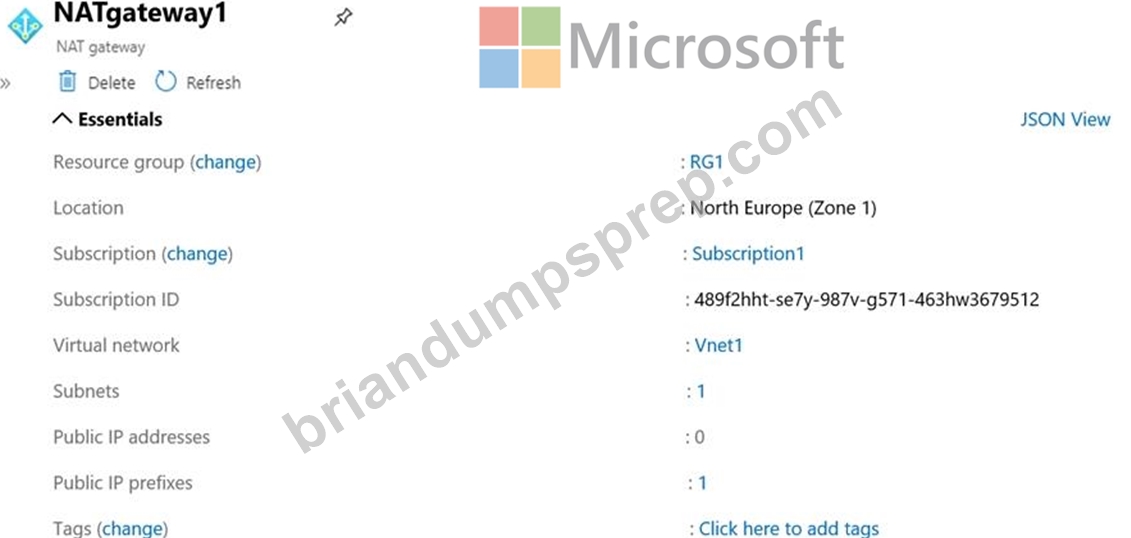
You have the virtual machine shown in the VM1 exhibit.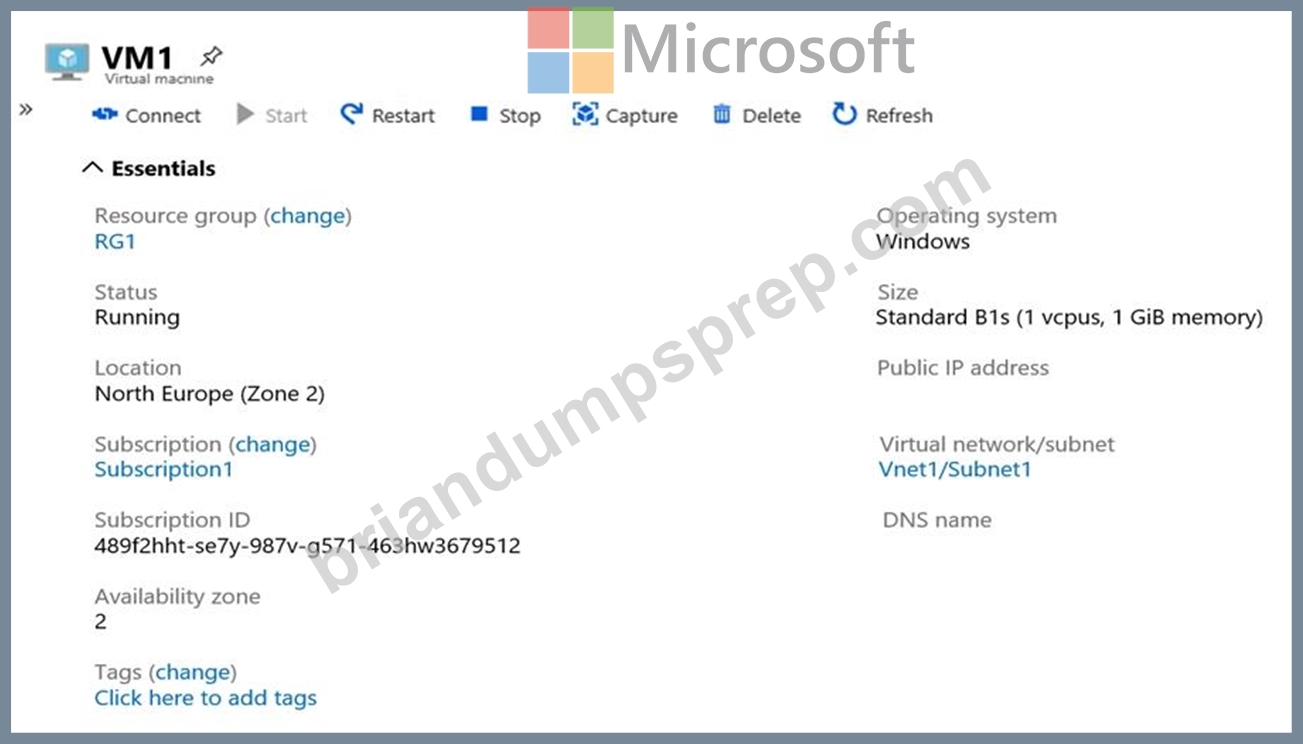
Subnet1 is configured as shown in the Subnet1 exhibit.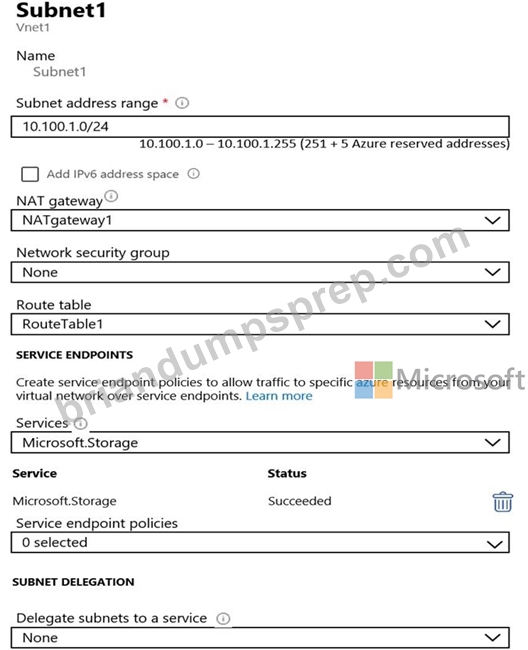
For each of the following statements, select Yes of the statement is true. Otherwise, select No.
NOTE: Each correct selection is worth one point.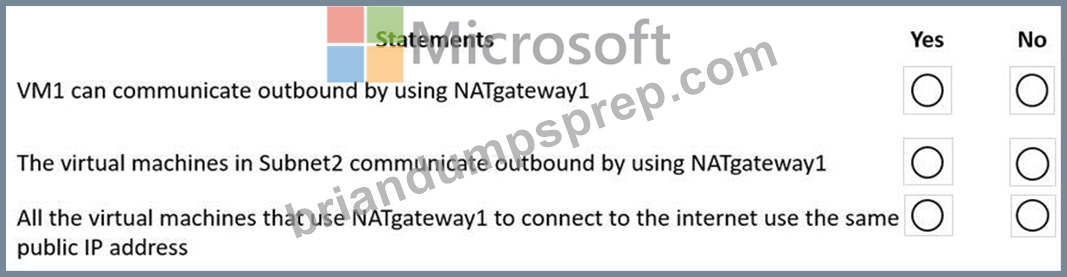
Answer:
Explanation: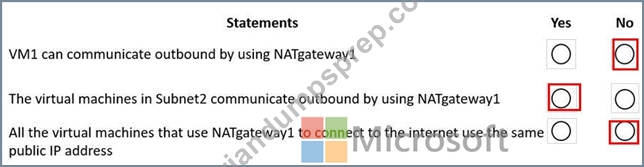
Reference:
https://docs.microsoft.com/en-us/azure/virtual-network/nat-gateway/nat-gateway-resource
NEW QUESTION # 199
You have an Azure subscription that contains an app named Appl. App1 is deployed to the Azure App Service apps show in the following table.
You need to publish App1 by using Azure Front Door. The solution must ensure that all the requests to App1 are load balanced between all the available worker instances.
What is the minimum number of origin groups and origins that you should configure? To answer, select the appropriate options in the answer area.
NOTE: Each correct selection is worth one point.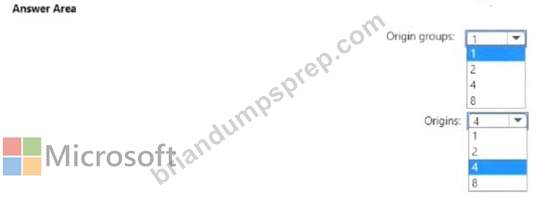
Answer:
Explanation: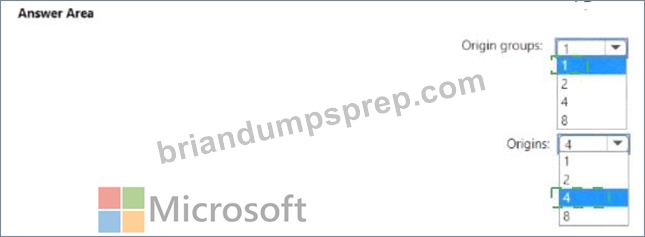
Explanation: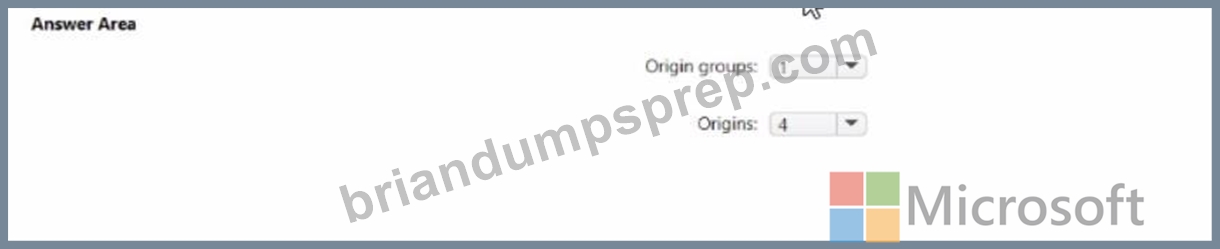
NEW QUESTION # 200
You have an Azure subscription that contains an Azure key vault named Vaultl and an app registration for an Azure AD app named App1.
You have a DNS domain named contoso.com that is hosted by a third-party DNS provider.
You plan to deploy App1 by using Azure App Service. App1 will have the following configurations:
* App1 will be hosted across five App Service apps.
* Users will access App1 by using a URL of https://app1.contoso.com.
* The user traffic of App1 will be managed by using Azure Front Door.
* The traffic between Front Door and the App Service apps will be sent by using HTTP.
* App1 will be secured by using an SSL certificate from a third-party certificate authority (CA).
You need to support the Front Door deployment.
Which two DNS records should you create, and to where should you import the SSL certificate for App1? To answer, select the appropriate options in the answer area.
NOTE: Each correct selection is worth one point.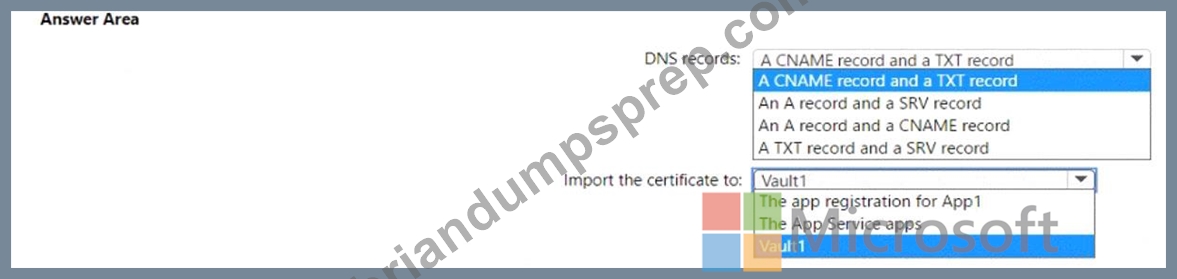
Answer:
Explanation: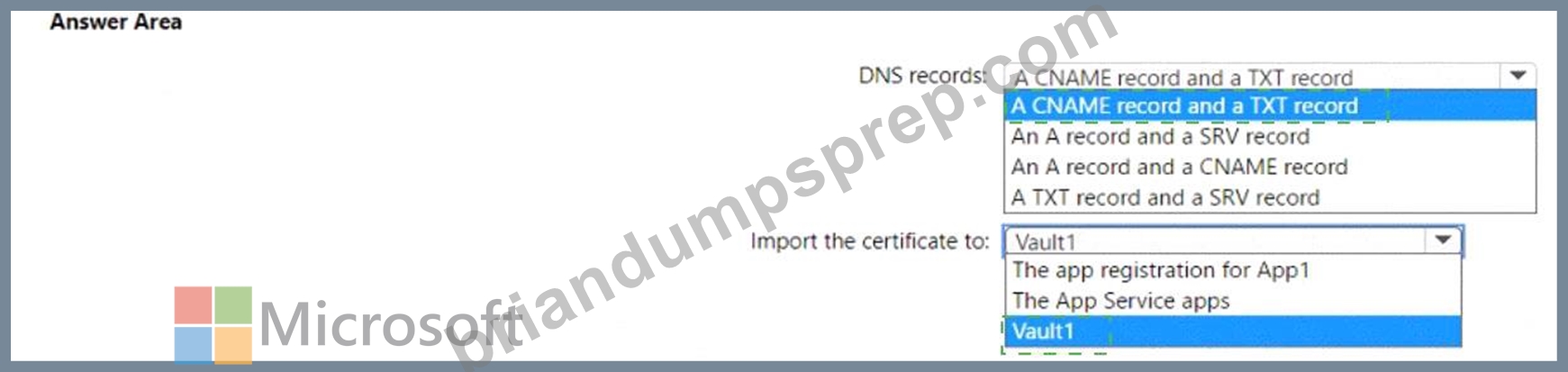
Explanation:
NEW QUESTION # 201
Task 4
You need to ensure that connections to the storage34280945 storage account can be made by using an IP address in the 10.1.1.0/24 range and the name storage34280945.pnvatelinlcblob.core.windows.net.
Answer:
Explanation:
See the Explanation below for step by step instructions.
Explanation
Here are the steps and explanations for ensuring that connections to the storage34280945 storage account can be made by using an IP address in the 10.1.1.0/24 range and the name stor-age34280945.pnvatelinlcblob.core.windows.net:
To allow access from a specific IP address range, you need to configure the Azure Storage firewall and virtual network settings for your storage account. You can do this in the Azure portal by selecting your storage account and then selecting Networking under Settings1.
On the Networking page, select Firewalls and virtual networks, and then select Selected networks under Allow access from1. This will block all access to your storage account except from the networks or resources that you specify.
Under Firewall, select Add rule, and then enter 10.1.1.0/24 as the IP address or range. You can also enter an optional rule name and description1. This will allow access from any IP address in the
10.1.1.0/24 range.
Select Save to apply your changes1.
To map a custom domain name to your storage account, you need to create a CNAME record with your domain provider that points to your storage account endpoint2. A CNAME record is a type of DNS record that maps a source domain name to a destination domain name.
Sign in to your domain registrar's website, and then go to the page for managing DNS settings2.
Create a CNAME record with the following information2:
Source domain name: stor-age34280945.pnvatelinlcblob.core.windows.net
Destination domain name: stor-age34280945.pnvatelinlcblob.core.windows.net Save your changes and wait for the DNS propagation to take effect2.
To register the custom domain name with Azure, you need to go back to the Azure portal and select your storage account. Then select Custom domain under Blob service2.
On the Custom domain page, enter stor-age34280945.pnvatelinlcblob.core.windows.net as the custom domain name and select Save2.
NEW QUESTION # 202
You have two Azure subscriptions named Sub1 and Sub2 that contain the resources shown in the following table.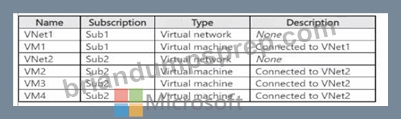
VNet1 and VNet2 are NOT connected.
You plan to create an Azure Private Link service named Link1 that will be used to connect VNet1 and VNet2.
You need to ensure that Link1 meets the following requirements:
* Ensures that VM1 can connect only to a web app hosted on VM2
* Prevents VM1 from connecting to the other resources that are connected to VNet2 Which additional resources should you create for each virtual network? To answer, drag the appropriate resources to the correct virtual networks. Each resource may be used once, more than once, or not at all. You may need to drag the split bar between panes or scroll to view content.
NOTE: Each correct selection is worth one point.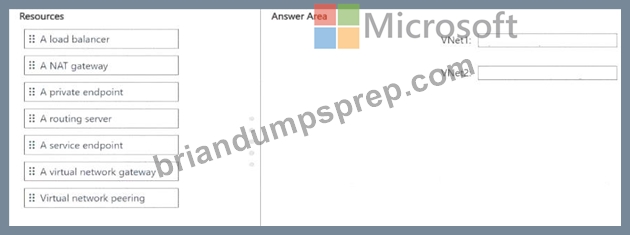
Answer:
Explanation: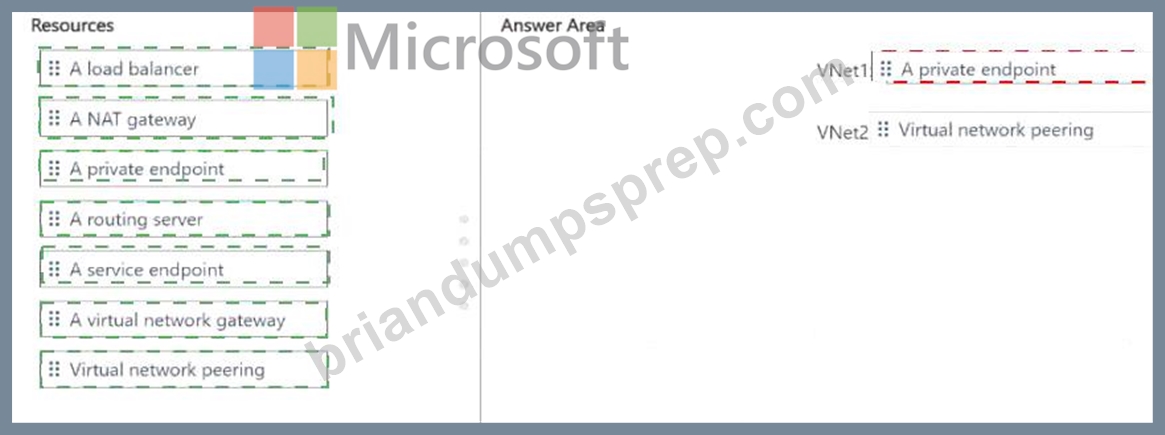
Explanation: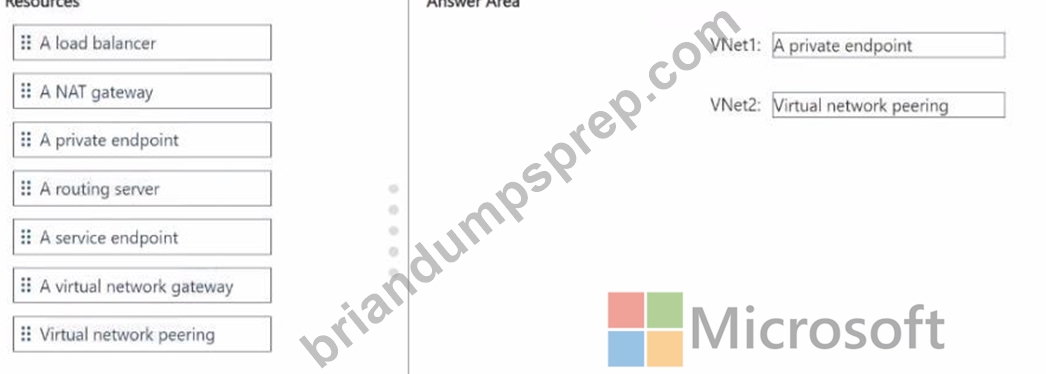
NEW QUESTION # 203
......
Exam AZ-700 Success: https://www.briandumpsprep.com/AZ-700-prep-exam-copyright.html
- Microsoft AZ-700 Exam | Practice Test AZ-700 Fee - Valuable Exam Success for your AZ-700 Studying ???? Search for ▷ AZ-700 ◁ and download exam materials for free through ▶ www.examcollectionpass.com ◀ ????Exam AZ-700 Answers
- Valid AZ-700 Exam Guide ⌨ AZ-700 Study Center ???? New AZ-700 Exam Guide ???? Search for “ AZ-700 ” and easily obtain a free download on ➠ www.pdfvce.com ???? ????AZ-700 Valid Exam Tutorial
- Latest copyright AZ-700 Book ???? Valid AZ-700 Learning Materials ???? AZ-700 Test Price ???? Search for 【 AZ-700 】 and download it for free on [ www.practicevce.com ] website ????Valid AZ-700 Exam Guide
- AZ-700 Exam Study Questions - AZ-700 Vce Training Material - AZ-700 Latest Pdf Vce ???? Copy URL ▛ www.pdfvce.com ▟ open and search for 「 AZ-700 」 to download for free ????Latest copyright AZ-700 Book
- New AZ-700 Exam Guide ???? AZ-700 Latest Test Dumps ???? AZ-700 Related Content ???? Search for “ AZ-700 ” and download exam materials for free through ▷ www.prep4sures.top ◁ ????Latest copyright AZ-700 Book
- Exam AZ-700 Answers ???? AZ-700 Valid Exam Tutorial ???? New AZ-700 Exam Guide ???? Open 《 www.pdfvce.com 》 enter 【 AZ-700 】 and obtain a free download ????Exam AZ-700 Answers
- AZ-700 Test Price ???? AZ-700 Reliable Test copyright ???? AZ-700 Valid Exam Question ???? Download ⏩ AZ-700 ⏪ for free by simply searching on 「 www.prepawaypdf.com 」 ????AZ-700 Related Content
- AZ-700 Test Price ???? Valid AZ-700 Exam Guide ???? AZ-700 Valid Exam Vce ???? Search for ☀ AZ-700 ️☀️ and download it for free on 【 www.pdfvce.com 】 website ????AZ-700 Online Version
- Microsoft AZ-700 Exam Questions In 3 User-Friendly Formats ???? Download “ AZ-700 ” for free by simply searching on [ www.vceengine.com ] ????AZ-700 Exam Sims
- Your Partner in AZ-700 Exam Preparation with Free Demos and Updates ???? Easily obtain ⮆ AZ-700 ⮄ for free download through 《 www.pdfvce.com 》 ????AZ-700 Exam Sims
- AZ-700 Online Version ♥ AZ-700 Valid Exam Tutorial ???? Valid AZ-700 Learning Materials ???? Search for ▶ AZ-700 ◀ and download exam materials for free through ➡ www.prepawayexam.com ️⬅️ ????Latest copyright AZ-700 Book
- lexiedwtu711310.blogpayz.com, studio-directory.com, funny-lists.com, ezekielbpzf625133.fliplife-wiki.com, abelpkdm509053.blogdeazar.com, rajanfsum880250.slypage.com, ihannaymsr603948.webdesign96.com, janapymq079490.birderswiki.com, bookmarkinginfo.com, laraaoom316272.buyoutblog.com, Disposable vapes
What's more, part of that BraindumpsPrep AZ-700 dumps now are free: https://drive.google.com/open?id=1Xa2m5SHduMBr6RqtUiJ5YSgY0ucRHwY1
Report this wiki page